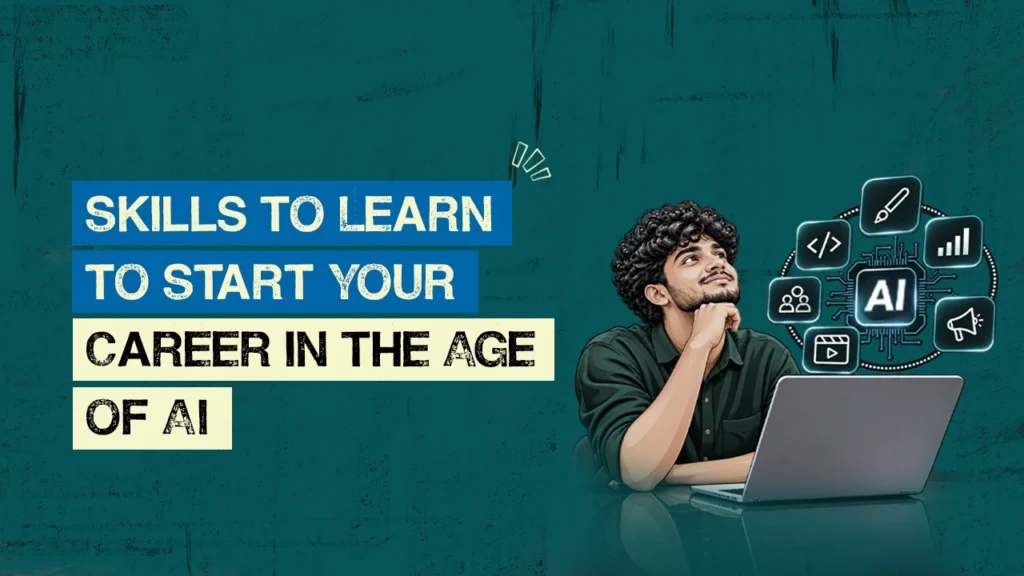
A few years ago, the advice for freshers was simple: get a degree, learn a bit of computer, and apply everywhere. Today, that advice feels incomplete. AI tools can now write emails, summarise reports, create designs and even draft code in seconds. So if you are just starting out, it is fair to ask: what is actually left for me to learn?
Here is the honest answer. AI has not made skills useless. It has changed which skills matter most. The people getting hired are not the ones who fear AI, and they are not the ones who blindly depend on it. They are the ones who know how to work with it.
Let’s walk through the skills that are worth your time.
1. Learn to use AI tools well, not just casually
Almost everyone has tried a chatbot by now. Very few people use it well. There is a big gap between typing a vague question and getting a vague answer, and knowing how to give clear instructions, check the result and improve it.
Start small. Pick one task from your daily life, like preparing study notes, planning a project or writing a first draft, and practise using AI for it. Notice where it helps and where it gets things wrong. Employers value someone who can say, “I used AI to finish this in half the time, and I double-checked the facts myself.”
The goal is not to let the tool think for you. It is to let the tool speed you up while you stay in charge.
2. Pair AI with one real, practical skill
This is the part many beginners miss. “Knowing AI” on its own is not a career. It becomes powerful when it sits on top of something concrete.
A marketer who understands customers and uses AI to test ideas faster. An accountant who uses AI to clean data and spot errors. A designer who uses AI for rough concepts and then adds real taste. In each case, the human skill comes first and AI makes it stronger.
So choose a field and go deep enough to be useful. It could be digital marketing, data analysis, web development, design, accounting, content writing or customer support. Which one you pick matters less than actually getting good at it.
3. Critical thinking and fact-checking
AI can sound very confident while being completely wrong. It can invent numbers, mix up facts and give advice that looks polished but does not hold up.
That is why the ability to question what you read is becoming more valuable, not less. Ask yourself: Does this make sense? Where did this come from? Can I verify it somewhere reliable? A person who catches a mistake before it reaches a client is worth far more than one who copies and pastes.
4. Clear communication, written and spoken
When everyone has access to the same tools, the way you communicate becomes the difference. Writing a clear message, explaining an idea simply, presenting your work in a meeting and handling a tricky conversation are skills that no tool can fully replace.
If you can explain something so that a busy person understands it in one minute, you are already ahead of most freshers. Practise by writing short summaries of what you learn, or by explaining a topic to a friend without using jargon.
5. Problem-solving and curiosity
Tools change fast. What you learn today might be updated next year. So the real skill is not memorising one tool, it is staying curious and figuring things out when something new shows up.
Get comfortable with not knowing. When you hit a problem, break it into smaller pieces, search, try, fail and try again. Employers notice people who say, “I haven’t done this before, but I’ll work it out,” and then actually do.
6. People skills and networking
It may sound old-fashioned, but a lot of opportunities still come through people. A referral, a recommendation or a simple conversation can open doors that hundreds of online applications cannot.
Be genuinely helpful in your circle. Connect with seniors, trainers and professionals in your field, share what you are learning, and keep in touch without only asking for favours. Building trust takes time, but it lasts.
7. Interview and resume skills
You can have good skills and still miss out if you cannot present them. Learn how to write a clean one-page resume, talk about your projects confidently and answer common interview questions honestly.
One tip: do not just list skills. Show proof. A small project, a sample report or a short case study says much more than “hardworking and quick learner.”
8. Adaptability and the habit of learning
The most future-proof skill is the habit of learning itself. Set aside a little time every week to pick up something new, whether it is a feature of a tool you already use or a basic concept in a field you are curious about. Small, steady effort beats a burst of motivation that fades in two weeks.
A simple way to get started
If all of this feels like a lot, here is a gentle plan:
- Month 1: Choose one practical field and learn the basics. Start using an AI tool for small tasks.
- Month 2: Build two or three small projects in that field and practise explaining them.
- Month 3: Prepare your resume, polish your online profile, talk to people in the industry and start applying.
You do not need to master everything. You need to be useful in one area, comfortable with AI, and able to communicate well.
Final thoughts
The age of AI is not the end of careers for beginners. It is a change in what employers look for. They want people who can think, communicate, learn quickly and use smart tools responsibly.
Start with one skill, practise it with real work, and let AI be your assistant rather than your replacement. If you would like guided, hands-on training to build job-ready skills, reach out to Skillage Academy and take the first step toward your career today.